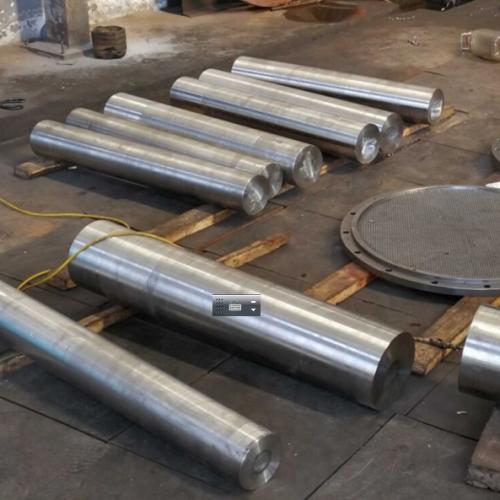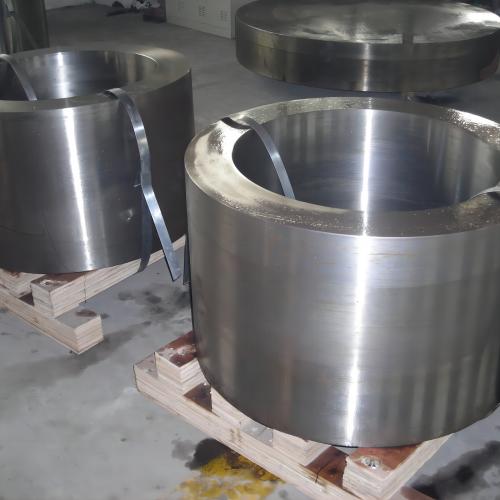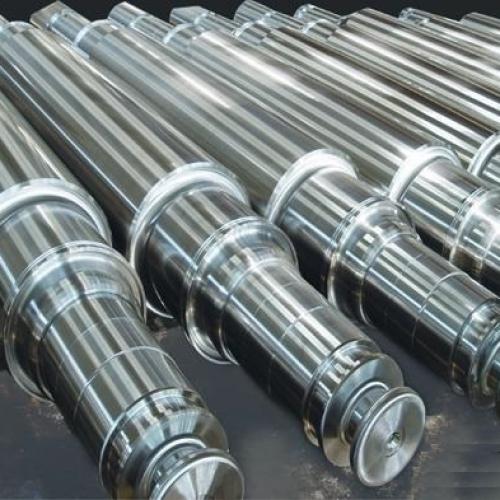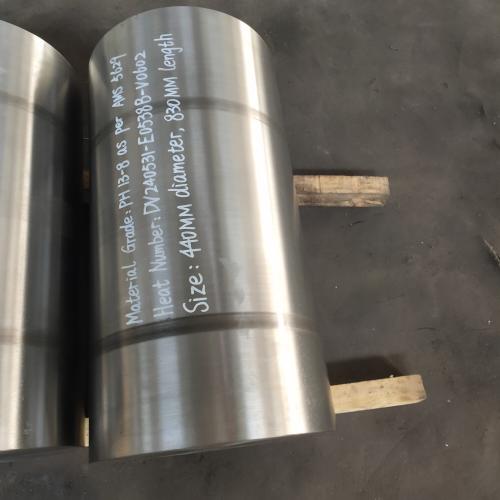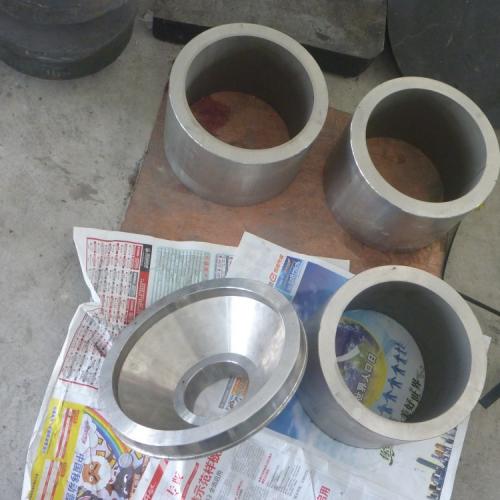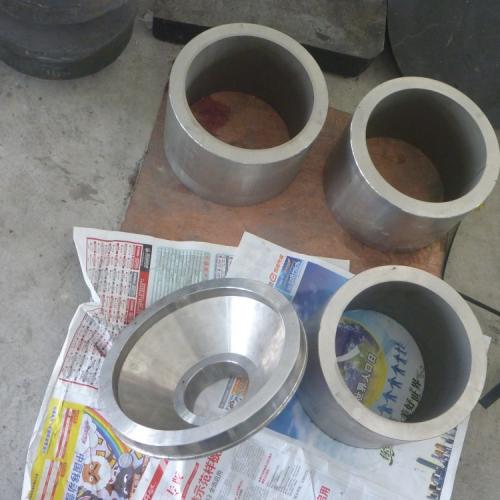
An F55 super duplex stainless steel valve bonnet is a forged pressure-retaining component made from ASTM A182 Grade F55 (UNS S32760 / Zeron 100), produced by upsetting, piercing and die forging, then solution annealed and water quenched. Because the valve bonnet is a high-integrity part used in offshore, subsea and sour-service valves, both its forged shape and its internal microstructure must be tightly controlled. This article describes the forging route, the heat-treatment principles and the full quality-verification program used to qualify F55 valve bonnets at Jiangsu Liangyi, manufacturer of ASTM A182 F55 forgings.
1. The F55 Valve Bonnet
A typical valve bonnet is a hollow component with large flanges on both sides — a fairly regular shape that suits a combined hammer-cogging and closed-die (impression) forging route. F55 places high demands on the starting material: it is melted by AOD refining with controlled nitrogen so that the cast composition meets the F55 specification before forging begins.
| C | Si | Mn | P | S | Cr | Ni | Mo | Cu | W | N |
|---|---|---|---|---|---|---|---|---|---|---|
| ≤0.030 | ≤1.00 | ≤1.00 | ≤0.030 | ≤0.010 | 24.0–26.0 | 6.0–8.0 | 3.0–4.0 | 0.50–1.00 | 0.50–1.00 | 0.20–0.30 |
The high Cr, Mo, W and N content gives a Pitting Resistance Equivalent Number (PREN = Cr + 3.3(Mo + 0.5W) + 16N) greater than 40 — the defining threshold for a super duplex grade.
2. Forging Process
The bonnet is forged through the following sequence:
- Upsetting — the heated cylindrical billet is upset on the press to break down the cast structure and refine the grain.
- Piercing — a tapered punch forms the central bore in the upset preform; the workpiece is then turned over and the connecting web is sheared out.
- Die forging — the pierced preform is finished to near-net shape in a dedicated bonnet die.
The single most important control is forging temperature, because the ferrite/austenite balance of super duplex steel is set thermally:
- Start-forging temperature is kept below ~1180 °C. Higher temperatures raise the ferrite fraction excessively, and a ferrite-heavy structure degrades toughness and corrosion resistance.
- Finish-forging temperature is kept above ~950 °C. Below this the alloy loses hot ductility and is prone to cracking; if the part cools below the limit, it is returned to the furnace, re-soaked and forged in a further heat.
Because super duplex steel has a narrow hot-working window and high deformation resistance, even through-heating and reheating discipline are essential. A minimum forging ratio of 3:1 ensures a sound, homogeneous structure. After forging and cooling, the bonnet is inspected for cracks, laps and dimensional conformance to the machining drawing.
3. Solution Heat Treatment
To dissolve any intermetallics formed during forging and re-establish a stable two-phase structure, the bonnet receives a solution anneal at 1100–1140 °C followed by rapid water quenching. The part is soaked until the centre reaches furnace temperature, then quenched fast enough to suppress re-precipitation of sigma (σ) and chi (χ) phases in the critical 600–1000 °C range. Keeping the quench water cold throughout (well below the point where it would slow cooling) is essential for heavy sections — slow cooling is the most common cause of intermetallic precipitation in production.
4. Quality Verification
Given the safety-critical duty of the bonnet, every solution-treated lot is qualified against four independent property checks plus internal-soundness testing. The values below are acceptance requirements; actual results are reported per heat / heat-treatment lot on the material certificate.
4.1 Mechanical Properties
Tensile testing follows ASTM A370. The forging must meet the minimum room-temperature requirements of ASTM A182 F55:
| Property | Requirement |
|---|---|
| Tensile strength | ≥ 750 MPa (109 ksi) |
| 0.2% proof / yield strength | ≥ 550 MPa (80 ksi) |
| Elongation | ≥ 25% |
| Hardness | ≤ 310 HBW |
4.2 Low-Temperature Impact
Charpy V-notch impact specimens are taken in both longitudinal and transverse orientations and at representative locations through the section, then tested at the specified low temperature (commonly −46 °C for subsea and offshore duty per ISO 148 / ASTM A370). Balanced, high absorbed energy with little scatter confirms a sound two-phase structure free of embrittling phases.
4.3 Pitting Corrosion (ASTM G48)
Resistance to chloride pitting is verified by ferric chloride immersion per ASTM G48 Method A. Ground specimens are exposed in 6% FeCl₃ at the qualified test temperature (typically up to ~50 °C for super duplex) for 24–72 hours; after a controlled cleaning sequence (rinse → brush → ultrasonic → alcohol dry) the mass loss per unit area is measured and the surface examined for pits. Low mass loss with no visible pitting confirms the high PREN is realised in the finished bonnet.
4.4 Detrimental Intermetallic Phase (ASTM A923)
The most damaging phase in super duplex steel is sigma (σ) — a hard, Cr- and Mo-rich tetragonal phase. Even a small fraction severely reduces ductility, toughness and corrosion resistance, and its presence signals incorrect forging temperature or inadequate quenching. Evaluation follows ASTM A923. Under optical microscopy at 400×, an acceptable structure shows uniformly distributed ferrite and austenite with clean, smooth grain boundaries and no intermetallic precipitates.
4.5 Ferrite Content (ASTM E562)
A balanced super duplex steel has a ferrite fraction of roughly 35–65%, achieved through chemistry control and correct solution treatment. Ferrite content is quantified by systematic manual point counting per ASTM E562 on an etched, polished specimen under the microscope. A result close to a 1:1 ferrite-to-austenite ratio confirms that both chemistry and heat-treatment cycle are correct.
4.6 Internal Soundness
Ultrasonic examination per ASTM A388 confirms freedom from internal defects, with hardness per ASTM E10 / E18. Material is supplied in compliance with API 6A (ISO 10423) and NACE MR0175 / ISO 15156 for sour service.
5. Conclusions
- A combined upsetting–piercing–die-forging route produces sound, defect-free F55 valve bonnets, provided forging starts below ~1180 °C to avoid excess ferrite and finishes above ~950 °C to avoid cracking.
- Solution annealing at 1100–1140 °C followed by rapid water quenching dissolves intermetallics and locks in a balanced two-phase structure.
- A complete verification program — mechanical and low-temperature impact testing, ASTM G48 pitting, ASTM A923 intermetallic-phase evaluation, ASTM E562 ferrite measurement and ASTM A388 ultrasonic examination — confirms the bonnet meets the strength, toughness and corrosion requirements of offshore and subsea valve service.
Related F55 Forgings
Jiangsu Liangyi forges the full set of super duplex valve components: valve bonnets, valve bodies, valve balls, stems, seat rings and closures — in ASTM A182 F55 (UNS S32760) and related grades such as SAF 2507 / UNS S32750.
Frequently Asked Questions
What forging process is used for F55 valve bonnets?
A combined upsetting, piercing and die-forging route, finished to near-net shape, then solution annealed at 1100–1140 °C and water quenched. Forging starts below about 1180 °C and finishes above about 950 °C.
Why must F55 be tightly temperature-controlled during forging?
Super duplex steel sets its ferrite-austenite balance thermally — too hot gives excess ferrite, too cold causes cracking — so the forging temperature must stay within a narrow window.
How is the quality of an F55 valve bonnet verified?
By tensile and low-temperature Charpy impact testing (ASTM A370), ferric chloride pitting (ASTM G48), intermetallic sigma-phase evaluation (ASTM A923), ferrite content measurement (ASTM E562) and ultrasonic examination (ASTM A388).
What ferrite content should F55 have?
Roughly 35–65%, ideally close to a 1:1 ferrite-to-austenite ratio.
Request a Quotation
Jiangsu Liangyi Co., Ltd. supplies certified F55 forged valve bonnets and ASTM A182 F55 (UNS S32760 / Zeron 100) forgings with full mechanical, corrosion and intermetallic-phase test certificates. Contact us at +86-510-86107550 or sales@forgepieces.com for a quotation.