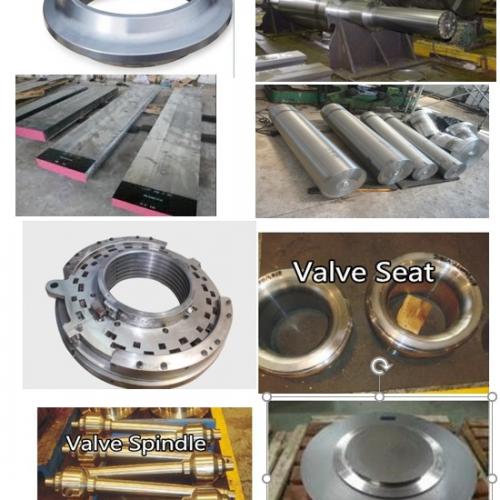
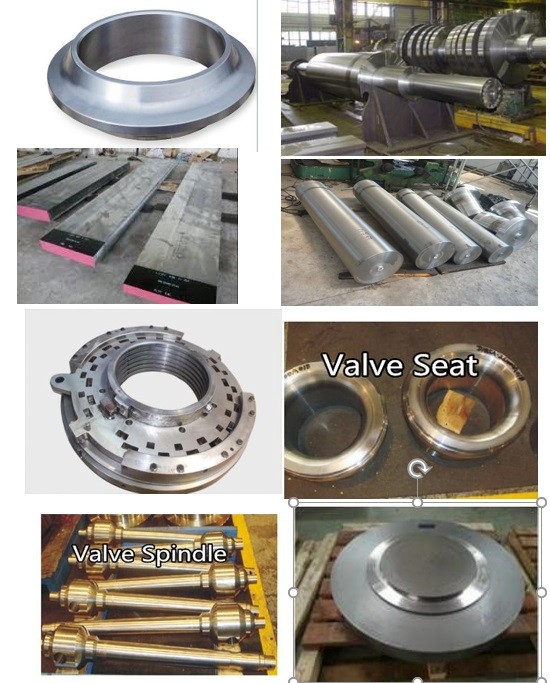
Description
Jiangsu Liangyi is a China-based open-die forging manufacturer of X22CrMoV12-1 / 1.4923 — a martensitic creep-resisting stainless steel used for turbine-blade flat bars, rings, discs, shafts and high-temperature fasteners. We melt by EF/EAF + LF + VD or by electroslag remelting (ESR) and deliver in the quenched-and-tempered (+QT) condition to EN 10269 and EN 10302.

At a glance — EN number 1.4923 · EN name X22CrMoV12-1 · martensitic creep-resisting · service to ~580–600 °C · max diameter 3 m · max weight 25 t · max length 12 m · delivered +QT.
The Grade We Forge: X22CrMoV12-1 (1.4923)
X22CrMoV12-1 (EN number 1.4923) is a heat-treatable martensitic creep-resisting steel with about 12% chromium plus molybdenum and vanadium. For a forging shop it is a demanding grade: its high creep-rupture strength and fatigue resistance are exactly what make it suitable for rotating and pressure-bearing turbine parts, but they also call for tight control of melting, forging temperature and the quench-and-temper cycle. We produce it to that standard — see our in-house heat-treatment and metallography records further down.
Typical end use is in steam and gas turbines, thermal power-plant machinery, pressure and steam boilers, and high-temperature bolting, where it performs reliably to roughly 580–600 °C. Its corrosion resistance is limited, so it is selected for heat and creep duty rather than wet-corrosion service.
Designations & Standards
| EN number | 1.4923 |
| EN name | X22CrMoV12-1 |
| Closely related grade | X20CrMoV12-1 (1.4922) |
| Production standards | EN 10269, EN 10302, DIN 17240, AD 2000 W7/W10 |
Looking for the ASTM, AISI, GOST or GB cross-reference? See our full guide: 1.4923 / X22CrMoV12-1 equivalent grades →
Chemical Composition
| C | Si | Mn | P | S | Cr | Mo | Ni | V | |
|---|---|---|---|---|---|---|---|---|---|
| Min | 0.18 | – | 0.40 | – | – | 11.0 | 0.80 | 0.30 | 0.25 |
| Max | 0.24 | 0.50 | 0.90 | 0.025 | 0.015 | 12.5 | 1.20 | 0.80 | 0.35 |
Heat analysis per EN 10269 / EN 10302, wt%.
Mechanical Properties
| Condition | Yield Rp0.2 (MPa) | Tensile Rm (MPa) | Elongation A (%) | Reduction Z (%) | Impact KV (J) | Hardness (HBW) |
|---|---|---|---|---|---|---|
| QT800 / +QT1 | ≥ 600 | 800–950 | ≥ 14 | ≥ 40 | ≥ 27 | — |
| QT900 / +QT2 | ≥ 700 | 900–1050 | ≥ 11 | ≥ 35 | ≥ 20 | 265–310 |
Physical Properties
| Density | 7.7 kg/dm³ |
| Thermal conductivity (20 °C) | ≈ 24 W/m·K |
| Specific heat (20 °C) | ≈ 460 J/kg·K |
| Mean thermal expansion (20–600 °C) | ≈ 12.5 µm/m·K |
| Magnetisable | Yes |
| Max. scaling resistance | ≈ 600 °C |
Forging & Heat Treatment
Forging
Pre-heat slowly to about 850 °C, then heat more rapidly to 1150–1180 °C. Forge in the range 950–1180 °C, finishing above 950 °C, and cool slowly afterwards in a furnace, dry ash or similar medium to avoid cracking.
Hardening & Tempering
Harden from 1020–1070 °C with quenching in air, oil or polymer. Temper in the range 640–740 °C (not below 650 °C for blade bars), followed by air cooling; the exact temperature is selected to reach the required strength class. Where bars are straightened after heat treatment, stress-relieve about 30 °C below the actual tempering temperature with a slow cooling rate to keep residual stresses to a minimum.
Available Forms from Jiangsu Liangyi
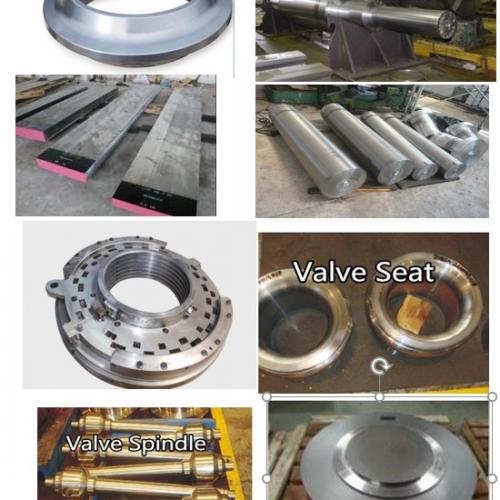
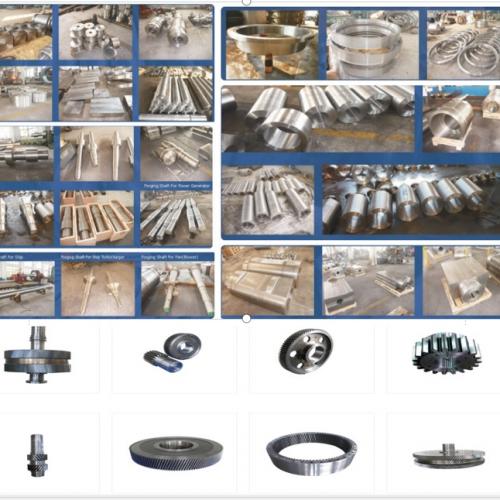
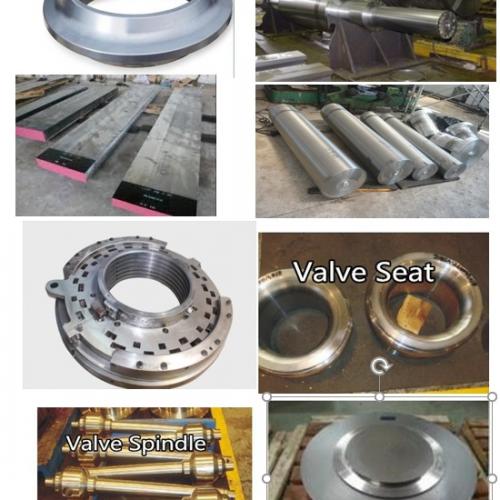
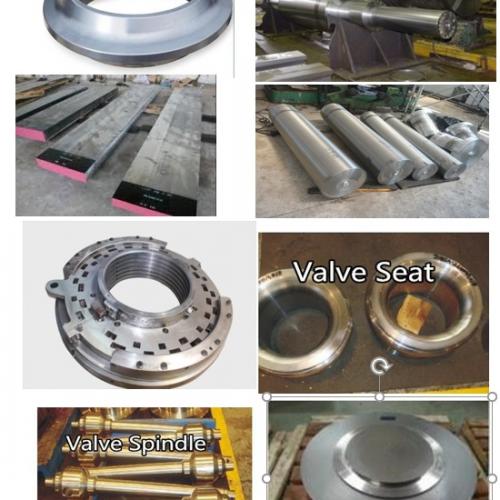
We supply 1.4923 / X22CrMoV12-1 as open-die and ring-rolled forgings, including:
- Turbine-blade / vane flat bars & rectangles
- Round bars, square bars & rods
- Seamless rolled rings & guide / seal / labyrinth rings
- Discs, blisks, wheels & impellers
- Sleeves, bushes, hollow bars & cases
- Hubs, housings, shells & casings
- Valve spindles, stems, seats & cores
- Studs, bolts & high-temperature fasteners
Maximum capabilities: diameter up to 3 m, unit weight up to 25 t, length up to 12 m. Melting is by EF/EAF + LF + VD or by ESR; the remelted (ESR) variant gives the highest purity and homogeneity.
X22CrMoV12-1 (1.4923) Forged Rings & Seamless Rolled Rings
Forged rings are one of our core forms in 1.4923 / X22CrMoV12-1. We produce seamless rolled rings and contoured forged rings up to 3 m outside diameter — including turbine guide rings, seal and labyrinth rings, packing seal rings, casing rings, blade-fitting rings, rotor end rings and bearing-housing rings. Ring-rolling gives continuous, circumferential grain flow for higher fatigue and creep strength than rings cut from plate or rolled-and-welded. Every X22CrMoV12-1 forged ring is supplied quenched and tempered (+QT1 / +QT2) with EN 10204 3.1 / 3.2 certification plus ultrasonic and magnetic-particle reports.
Typical Applications
- Steam- and gas-turbine blades & vanes
- Turbine rotor discs, wheels & blisks
- Diaphragms, nozzles & seal rings
- Turbine casings & heat shields
- Control / reheat valve discs & spindles
- High-temperature studs & bolting
- Pressure & steam-boiler components
Quality, Testing & Standards
Forgings are produced and certified to EN 10269, EN 10302, DIN 17240, VdTÜV 110 and AD 2000-Merkblatt W7/W10, with EN 10204 3.1 / 3.2 certification and third-party inspection (TÜV, DNV, BV, SGS) available on request. Standard testing covers chemical analysis, mechanical and hardness testing, Charpy V-notch impact, metallography (delta-ferrite < 5%, grain size 4 or finer per ASTM E112), ultrasonic testing to SEP 1923, magnetic-particle inspection and full traceability by melt and heat-treatment batch.
Original Test & Inspection Records (in-house data)
The reports below are from our own X22CrMoV12-1 (1.4923) production — not stock images. They show the actual heat-treatment cycle and metallographic results behind a delivered batch of forged turbine-blade flat bars, with full traceability by job and steel-ingot number. Click any image to open the full-size version.
Heat-Treatment Records (Q+T)
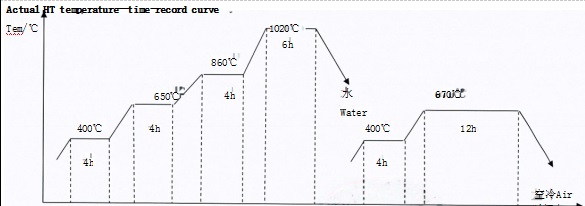
Actual temperature–time record curve, X22CrMoV12-1 forged flat bars (vertical furnace, Q+T).
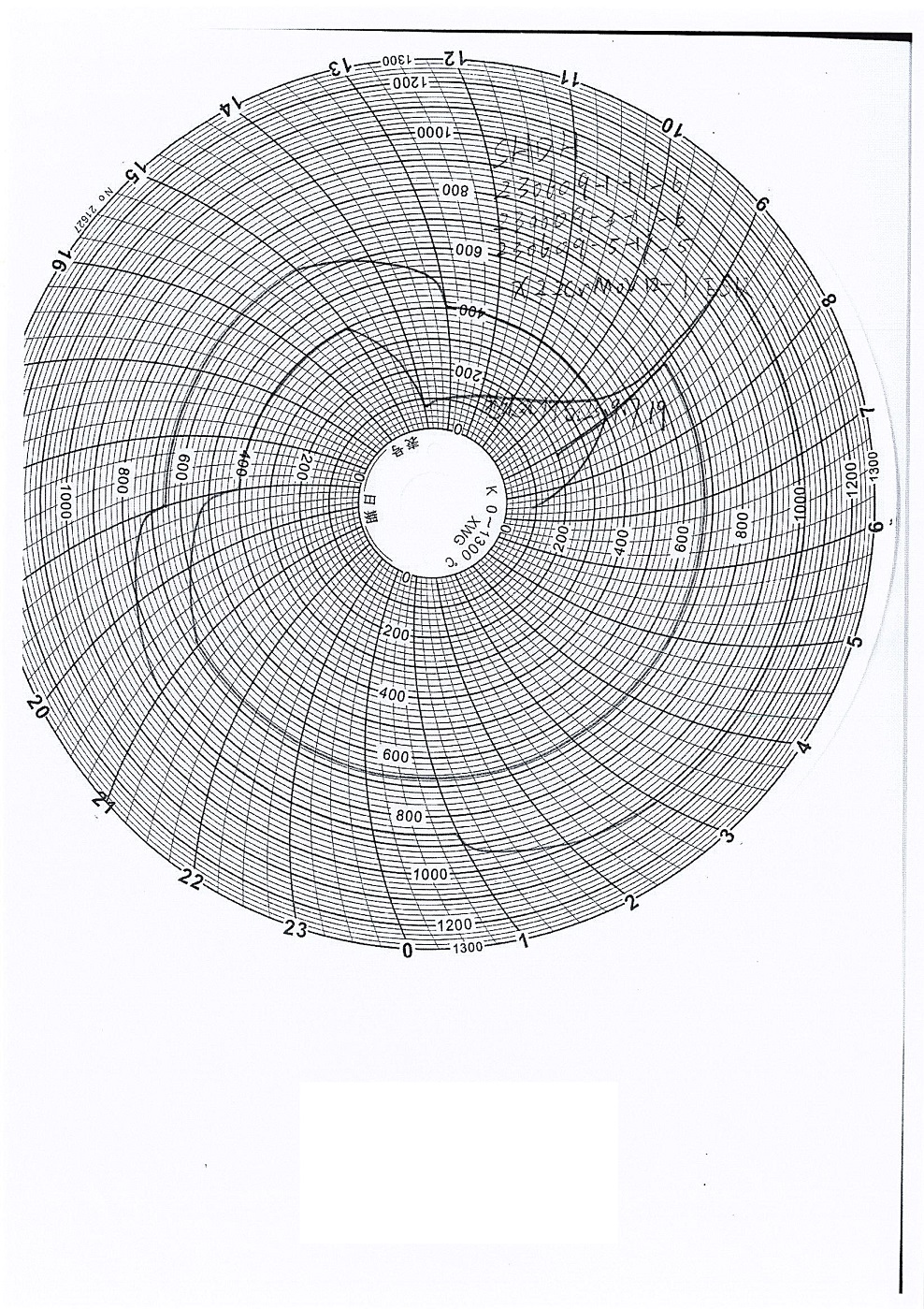
Heat-treatment chart, X22CrMoV12-1 forged steel flat bars.
The recorded cycle for this batch: stepped pre-heat at 400 °C, 650 °C and 860 °C, austenitising at 1020 °C for 6 h, water quench; then tempering with a 400 °C hold followed by a 670 °C / 12 h soak and air cooling — placing the bars in the quenched-and-tempered (+QT) condition for turbine-blade service (recorder chart range 0–1300 °C).
Heat-treatment report HT230922001 — X22CrMoV12-1 ESR forged square bars (Q+T, vertical furnace, HT No. 23090719, inspected 2023-09-09):
| Size (in) | Item | Job No. | Material | Steel ingot No. |
|---|---|---|---|---|
| 6.25 × 9.5 × 156 | Forged square bar | WXX-SHDH230609-1-1 | X22CrMoV12-1 ESR | 1230709 |
| 6.25 × 9.5 × 156 | Forged square bar | WXX-SHDH230609-1-2 | X22CrMoV12-1 ESR | 1230713 |
| 6.25 × 9.5 × 156 | Forged square bar | WXX-SHDH230609-1-3 | X22CrMoV12-1 ESR | 1230714 |
| 6.25 × 9.5 × 156 | Forged square bar | WXX-SHDH230609-1-4 | X22CrMoV12-1 ESR | 1230715 |
| 6.25 × 9.5 × 156 | Forged square bar | WXX-SHDH230609-1-5 | X22CrMoV12-1 ESR | 1230716 |
| 6.25 × 9.5 × 156 | Forged square bar | WXX-SHDH230609-1-6 | X22CrMoV12-1 ESR | 1230717 |
| 8.25 × 8.25 × 156 | Forged square bar | WXX-SHDH230609-3-1 | X22CrMoV12-1 ESR | 1230701 |
| 8.25 × 8.25 × 156 | Forged square bar | WXX-SHDH230609-3-2 | X22CrMoV12-1 ESR | 1230702 |
| 8.25 × 8.25 × 156 | Forged square bar | WXX-SHDH230609-3-3 | X22CrMoV12-1 ESR | 1230703 |
| 8.25 × 8.25 × 156 | Forged square bar | WXX-SHDH230609-3-4 | X22CrMoV12-1 ESR | 1230704 |
| 8.25 × 8.25 × 156 | Forged square bar | WXX-SHDH230609-3-5 | X22CrMoV12-1 ESR | 1230705 |
| 8.25 × 8.25 × 156 | Forged square bar | WXX-SHDH230609-3-6 | X22CrMoV12-1 ESR | 1230706 |
| 8.25 × 9.5 × 156 | Forged square bar | WXX-SHDH230609-5-1/-2 | X22CrMoV12-1 ESR | 1230712 |
| 8.25 × 9.5 × 156 | Forged square bar | WXX-SHDH230609-5-3 | X22CrMoV12-1 ESR | 1230707 |
| 8.25 × 9.5 × 156 | Forged square bar | WXX-SHDH230609-5-4 | X22CrMoV12-1 ESR | 1230708 |
| 8.25 × 9.5 × 156 | Forged square bar | WXX-SHDH230609-5-5 | X22CrMoV12-1 ESR | 1230710 |
Metallographic Test Report
Microstructure was examined on these forged turbine flat bars to international standards, confirming a uniform tempered-martensitic structure. Measured results from this batch:
| Property | Standard | Acceptance | Measured result |
|---|---|---|---|
| Non-metallic inclusions | ASTM E45 Method A | each type ≤ 3.0 | A 0.5 / 0.5 · B 0 / 0 · C 0.5 / 0 · D 1.0 / 0.5 (thin / heavy) |
| Delta-ferrite content | ASTM E562-11 | ≤ 1 % | 0.4 % |
| Decarburised layer | — | ≤ 0.06 in | 0.0079 in (≈ 0.20 mm) |
| Grain size | ASTM E112 | ≥ grade 5 | grade 7.0 |
Every result sits well inside the acceptance limit — clean, fine-grained (ASTM E112 grade 7.0), low-delta-ferrite (0.4 %) metal suited to fatigue- and creep-loaded turbine parts.
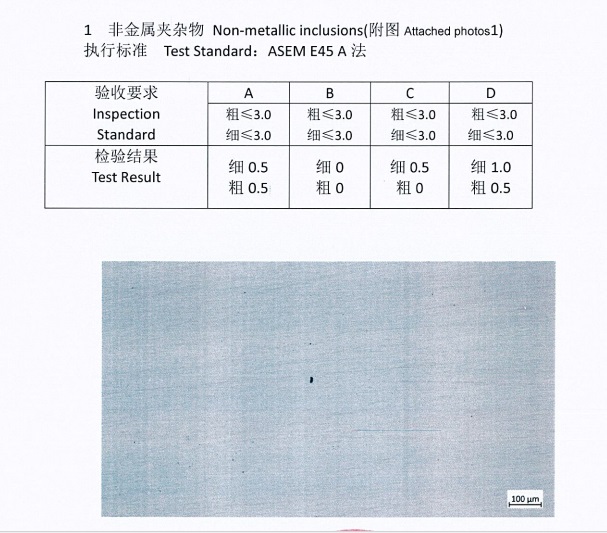
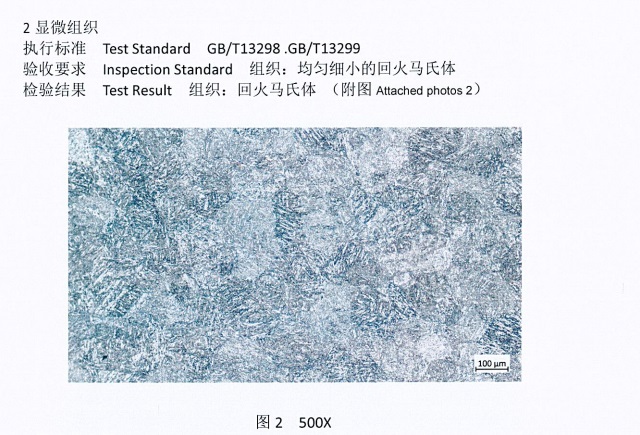
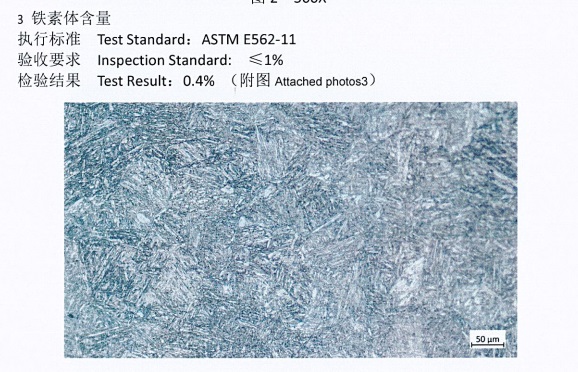
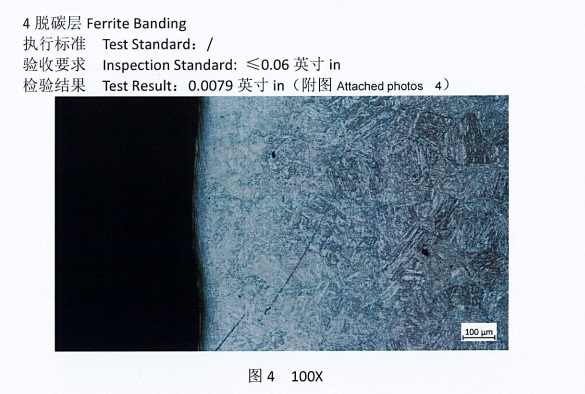
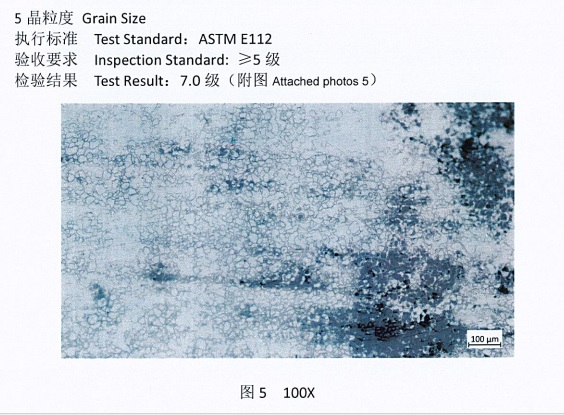
Metallographic test report — X22CrMoV12-1 (1.4923) forged turbine flat bars, Jiangsu Liangyi.
Frequently Asked Questions
What sizes and forms of 1.4923 forgings can you supply?
Open-die and ring-rolled forgings up to 3 m diameter, 25 t unit weight and 12 m length — including turbine-blade flat bars, round and square bars, seamless rolled rings, discs, sleeves, valve parts and fasteners.
What melting routes and delivery conditions are available for X22CrMoV12-1?
Melting by EF/EAF + LF + VD (vacuum degassed) for general work, or electroslag remelting (ESR) for fatigue-critical turbine bars. Delivery is normally quenched and tempered — +QT1 (QT800) or +QT2 (QT900), with optional stress relief (+SR).
What certification and testing do you provide for X22CrMoV12-1?
EN 10204 3.1 / 3.2 certificates with third-party inspection (TÜV, DNV, BV, SGS) on request. Standard scope covers chemical analysis, mechanical and hardness testing, Charpy impact, metallography, ultrasonic testing to SEP 1923 and magnetic-particle inspection.
Up to what temperature can X22CrMoV12-1 be used?
Scale-oxidation resistance holds to about 600 °C, with practical continuous-service strength generally rated to around 580 °C.
Need the ASTM / AISI equivalent or a 1.4923 vs 1.4922 comparison? See our 1.4923 equivalent-grades guide →
Need X22CrMoV12-1 (1.4923) forgings?
Send your drawing, specification and required condition for a quotation.
Phone +86-510-86107550 · Email sales@forgepieces.com